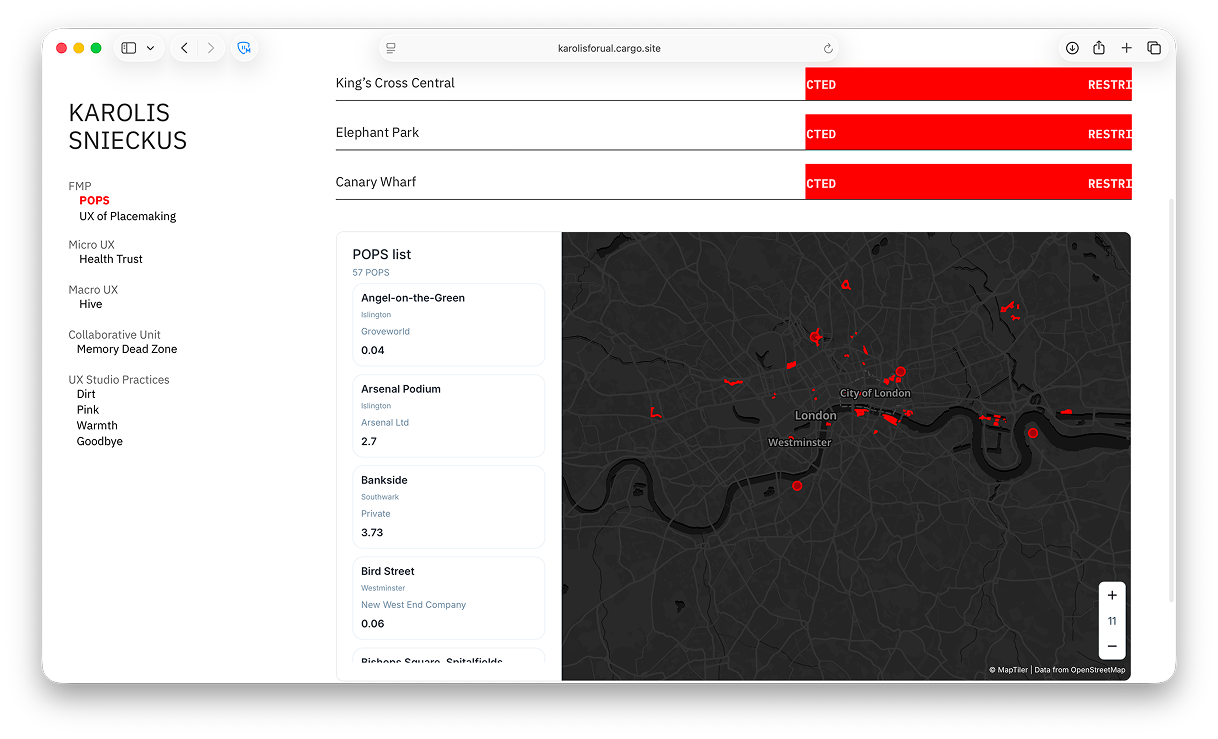
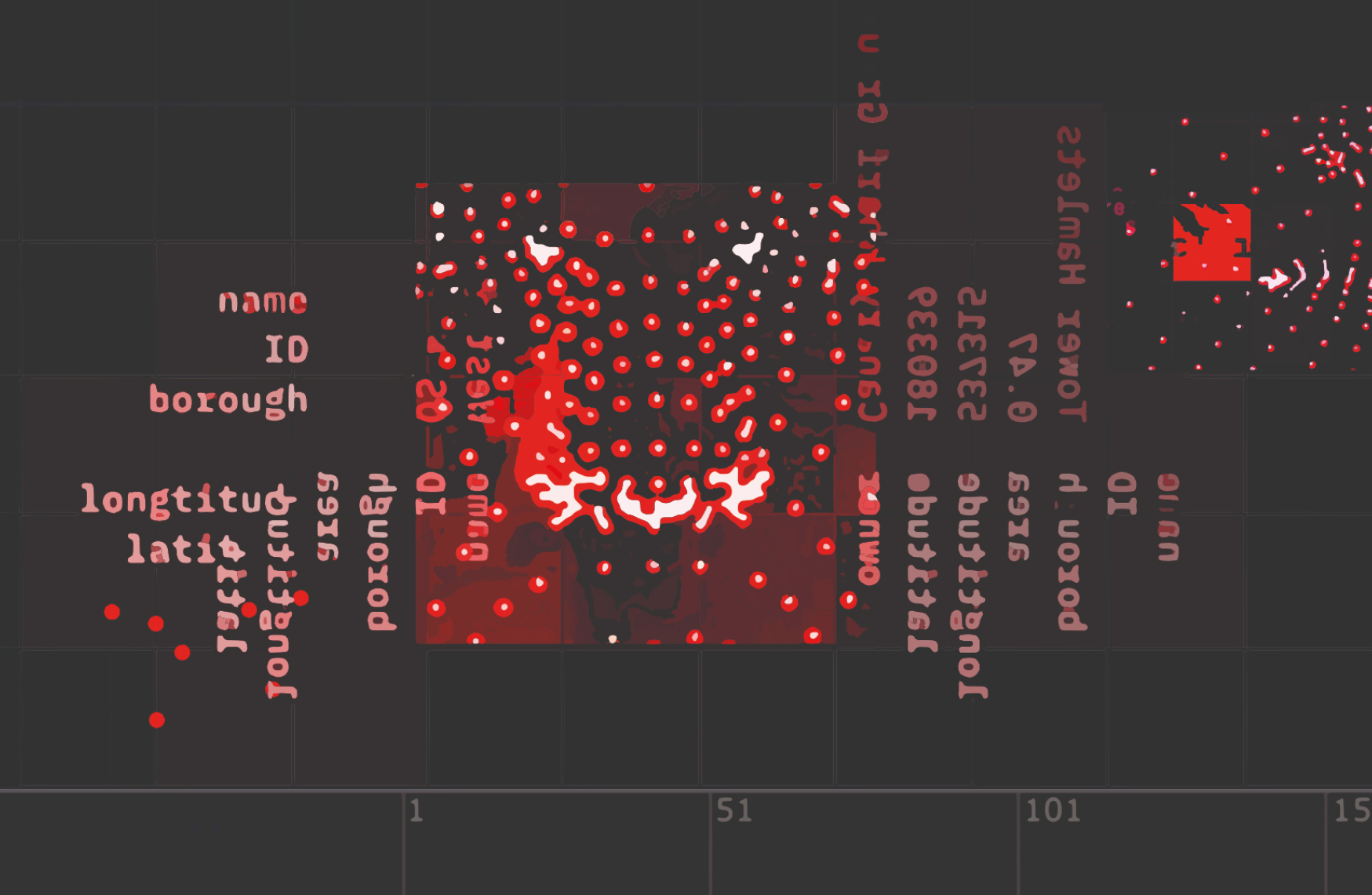
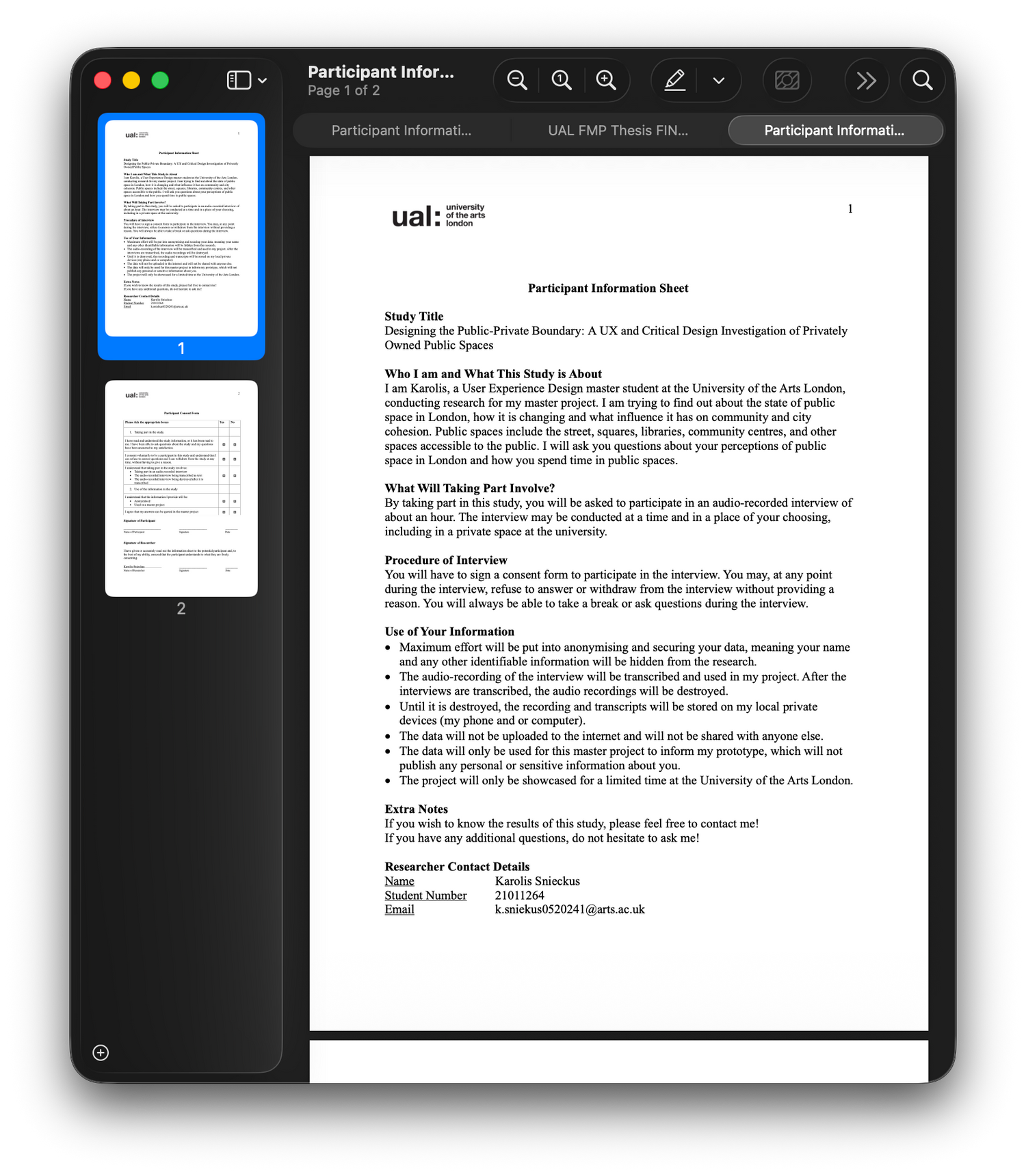
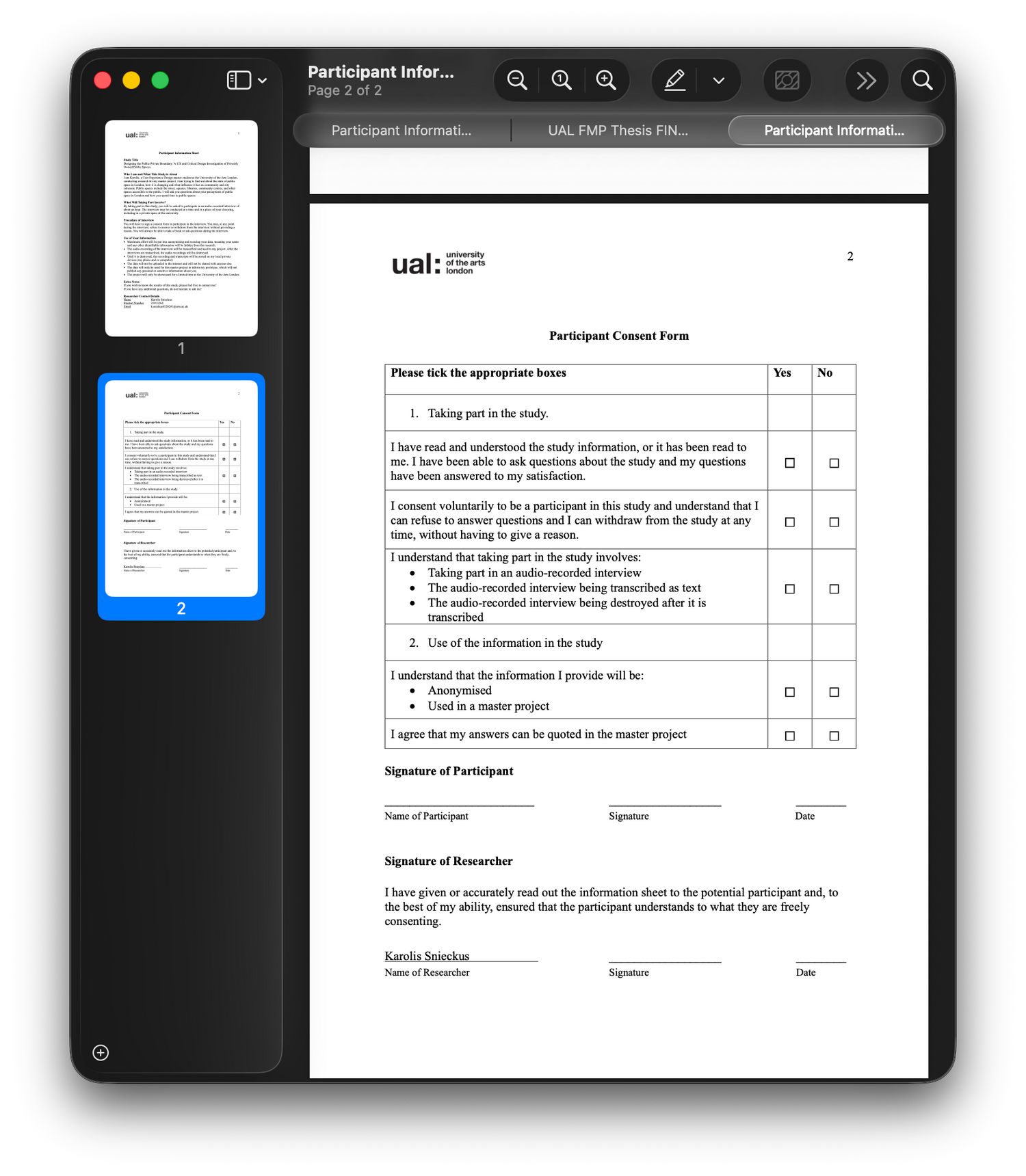
Secondary research, including academic sources, journalism, and a since-restricted public POPS dataset, was combined with interviews and site observation to identify three recurring dynamics: the gap between perceived and actual publicness, behavioural self-regulation in the absence of visible rules, and surveillance as an atmospheric rather than purely technological condition. Interviews were coded in Atlas.ti concurrently with data collection, allowing early findings to inform subsequent interview questions. These findings converged on a core interaction: a mandatory face scan prior to entry, directly informed by CCTV privacy policies at sites such as King's Cross Estate, which disclose the capture of attributes including clothing and hair colour without users' awareness. The interaction was built end-to-end in TouchDesigner, incorporating face detection, a command-line-style interface displaying live POPS data such as owner, borough, and coordinates via custom Python scripts, and a restriction sequence using custom Google Earth and Maps footage. DaVinci Resolve and After Effects were used interchangeably for map tracking depending on task requirements, and the TouchDesigner network was restructured into modular scenes to support ongoing iteration. The project was initially scoped across six POPS sites, then reduced to three, Elephant Park, Canary Wharf, and King's Cross, based on interview and observational data, prioritising depth and clarity of experience over breadth of coverage. Sound was developed as a core component of the experience rather than a placeholder element, and the visual language was informed by Ryoji Ikeda's data-driven aesthetic and Apple's Face ID interface, establishing familiarity and authority while improving the legibility of dense information. Given the use of a live camera feed, a formal risk assessment addressed consent and data misuse. Safeguards included activation only on explicit user action, local processing, no storage or transmission of footage, and immediate discarding of facial landmark data, supported by a visitor-facing information sheet to ensure transparency. A late-stage hardware performance issue was also resolved by downscaling resolution and implementing custom pixel-format and interpolation handling in Python, stabilising playback for public exhibition.
.png)
.png)